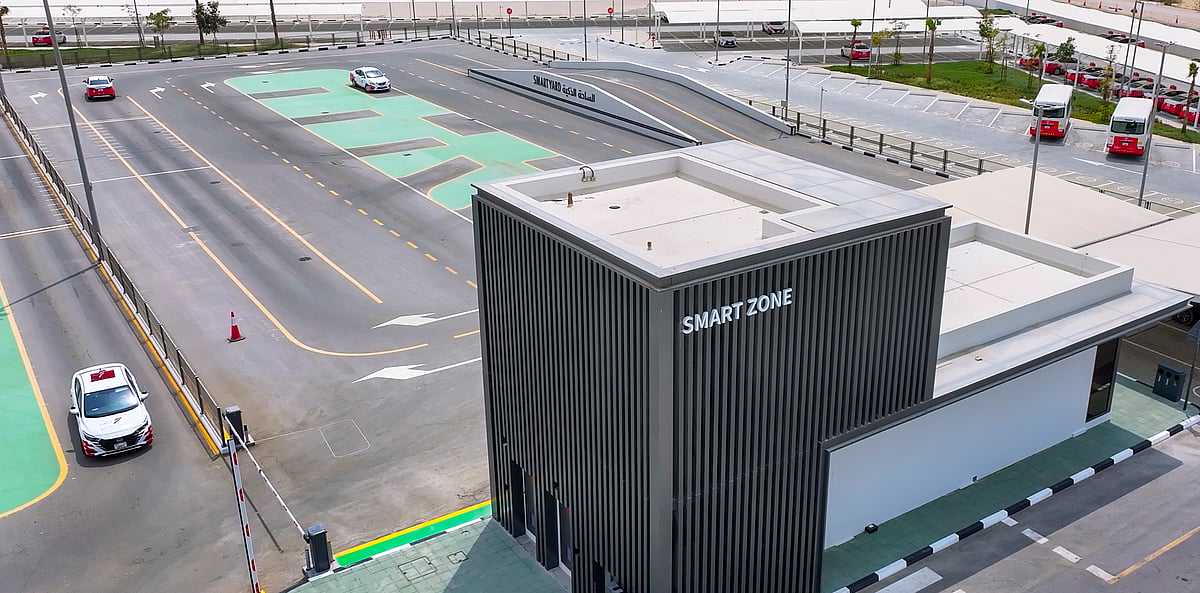
Dubai's Roads and Transport Authority has introduced a next-generation version of its Smart Test System (STS) for light-vehicle yard driving tests, folding artificial intelligence, computer vision and precision vehicle tracking into how learner drivers are graded.
The system automatically monitors a candidate's manoeuvres against standardised criteria and calculates the final result without any human intervention, according to the RTA. Smart cameras track whether learners check their mirrors, scan blind spots and keep their hands correctly positioned on the wheel. Underpinning the tracking is Real-Time Kinematic positioning technology, accurate to within two centimetres, which builds an interactive 3D map of the vehicle's exact route during the test. A facial-recognition layer confirms that the result belongs to the right candidate, while automatic braking can intervene to prevent a collision mid-test.
For many learners, the standout feature is the ability to review a recording of their own test afterwards. Instead of simply being told they failed, candidates can see precisely where and why an error occurred — a missed mirror check, a late signal, an unsafe gap. The RTA frames this transparency as the core purpose of the upgrade: a consistent, documented assessment removes the perception that outcomes hinge on an individual examiner's mood or judgement.
The rollout sits alongside other digital pushes in Dubai's transport sector in recent years, including instant licence issuance and automated violation-monitoring systems. For anyone preparing for a UAE driving test, it means a process that is less about reading an examiner and more about meeting a fixed, visible standard — with the evidence to back up the result if it doesn't go your way.