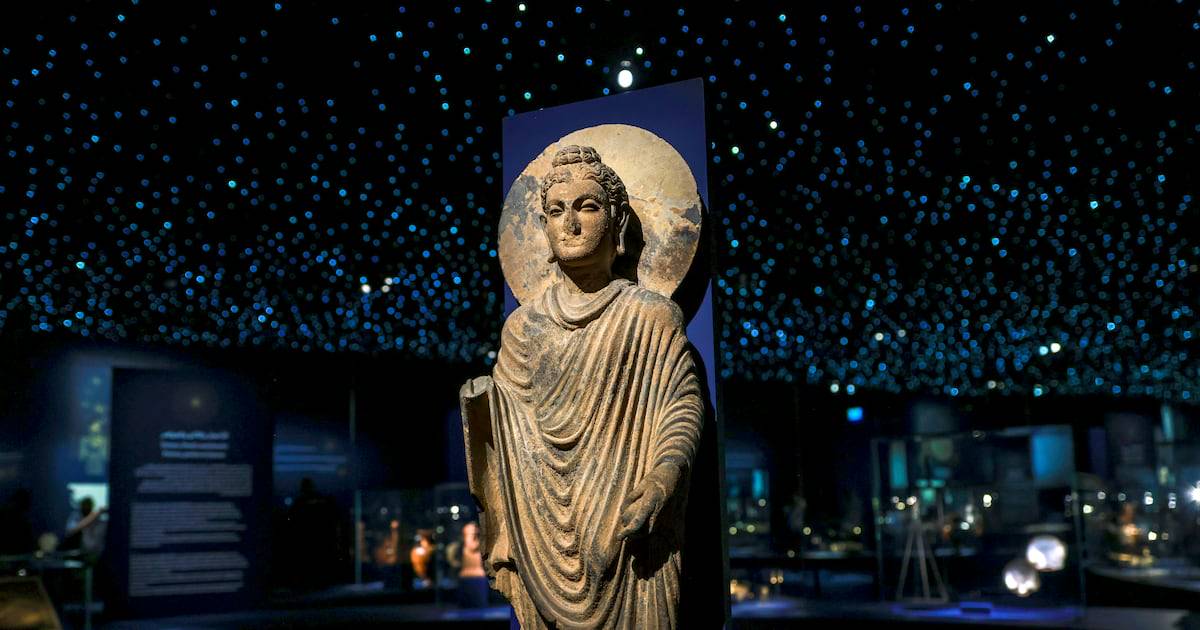
A new exhibition has opened at Louvre Abu Dhabi tracing a thousand years of maritime trade across the Indian Ocean, bringing together roughly 240 artworks and objects on loan from 24 institutions worldwide. "Spices and Wonders: Sailing the Indian Ocean", staged in partnership with the Guimet - National Museum of Asian Arts in Paris, runs until mid-February next year.
The show follows trade routes that linked Africa, the Middle East, Europe, South Asia and Southeast Asia from antiquity through the 17th century, built around the goods that moved along them: spices, textiles, ceramics and other cargo that passed between ports across three continents.
Its centrepiece is a set of six large ship models, each built over roughly a year in South Africa, representing distinct shipbuilding traditions: Arabian, Southeast Asian, Chinese, Portuguese and Spanish. They sit alongside artefacts recovered from actual shipwrecks, giving visitors a physical sense of the vessels that once carried these goods.
The exhibition gives particular weight to the Arabian Gulf's own role in this history, especially its pearling industry, positioning the region as a long-standing link between East Africa and Asia rather than a peripheral stop on someone else's trade map. Among the more striking loans on display is cargo salvaged from a Spanish galleon that sank in 1600 after an encounter with Dutch ships; part of a 32-piece loan from the Philippines now on view in Abu Dhabi for the first time.
The exhibition forms part of Louvre Abu Dhabi's broader new cultural season and is open to visitors with a standard museum ticket.